.png)
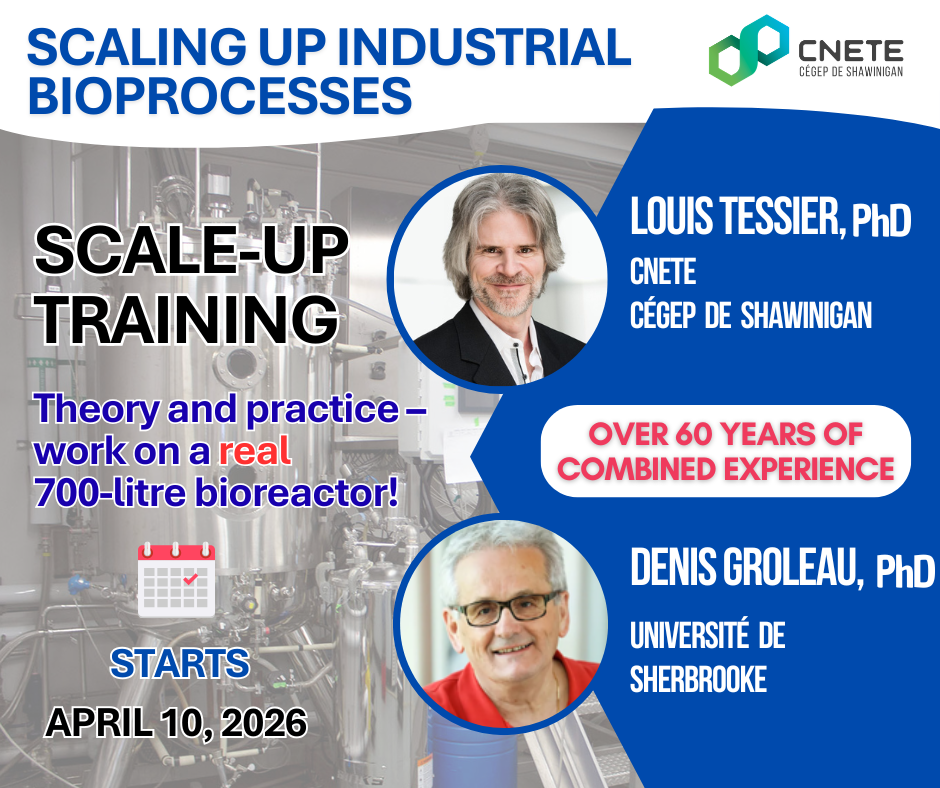
CNETE offers training in industrial bioprocesses, focused on scaling up fermentative bioprocesses to advance toward commercialization.
REGISTRATION DEADLINE: April 3rd, 2026
FEES
Theoretical training (online), followed by practical training (at CNETE in Shawinigan) | Includes PDF training documents for all covered modules, as well as a printed copy of the bioreactor assembly protocols, bioprocess start‑up procedures, analytical methods, a checklist, and a data entry table.
The training will be held only if a sufficient number of participants register. If the number of participants is insufficient to start a cohort, any payments already made will be refunded, if applicable.
IMPORTANT
DATE OF THE NEXT COHORT: Starts Friday, April 10th, 2026
DATES: The theory portion will take place in four 4‑hour blocks, one per week (8:30 a.m. to 12:30 p.m.), online, from April 10th to May 1st, 2026.
The practical portion is delivered over two and a half days in at CNETE’s facilities, in Shawinigan, QC, following consultations with registered participants. Indicative target dates: first two weeks of June.
PRICING
Theory (online): Regular – $1,500 / Student – $1,000
Practice (on-site in Shawinigan, QC): Regular – $3,750 / Student – $3,000
A $250 rebate will be applied for a registration in both theory and practical training.
A registration is considered confirmed only once payment has been received.
Accepted payment methods: cheque or bank transfer only.
For any questions: Nicholas Berrouard (nberrouard@cnete.qc.ca) / Nicolas Viau (nviau@cnete.qc.ca).
DESCRIPTION
CNETE has recently developed an entirely new theoretical and practical training program on the scale‑up of microbial fermentation processes, in response to a growing demand from companies, industries, graduate students, research centers, government laboratories, and others working directly or indirectly in the field of biotechnology—and more specifically in industrial bioprocessing.
Scaling up a fermentation process remains relatively unknown and is complex to execute. Many companies encounter difficulties during this phase, as they are often not adequately prepared to face this major challenge.
This new training, will go further than CNETE’s other bioprocesses program, which focuses on the basics, emphasizing instead the critical aspects of scale‑up, common pitfalls to avoid, and intelligent ways to navigate the issues encountered.
It is intended both for individuals who completed basic bioprocess training and for experienced personnel in microbial fermentation who wish to enhance their theoretical and practical knowledge. This training will be offered in Fall 2025.
OUR INSTRUCTORS
Denis Groleau, PhD

Adjunct professor at Université de Sherbrooke, consultant and collaborator at CNETE.
Experience
- Research officer at Biotechnology Research Institute, Biochemical Engineering Section, and
- Microbial Fermentation Pilot Plant (NRC, Montreal) 1987-2012
- Mounting and giving a training program dealing with pilot-scale microbial fermentation and primary recovery (1992-1995)
- Professor-researcher at Université de Sherbrooke (Faculty of Engineering) as a Tier 1 Canada Research Chair holder (2012-2021)
Research skills
- Various groups of microorganisms including genetically engineered ones
- Biopolymers, technical or pharmaceutical enzymes, recombinant peptides and proteins, microbial inoculants, vaccines, vaccine adjuvants, plasmids, etc.
- Technologies of bioreactors
Louis Tessier, PhD

Professor at Cégep de Shawinigan, and associate researcher at CNETE
Experience
- Professor at the department of biology and biotechnologies since 2000 (Laboratory Techniques in Biotechnology and the Natural Sciences programs)
- Teacher of the Industrial Bioprocess course for the last 23 years (wrote a book in French used by colleges and universities)
- Conducting applied researches in industrial bioprocesses at the CNETE
Research skills
- Optimization of culture medium, fermentation conditions, modes of fermentation with wildtype and recombinant strains, scaling-up bioprocesses
- Purification technologies (membrane filtration, continuous centrifugations, chromatography, distillation, freeze and spray-drying, precipitation, etc.)
- Biosurfactants, biopolymers, fragrances, exoenzymes, proteins, fatty and organic acids…
- Bioreactor technologies
TRAINING CURICULUM
Intensive Theory (online)
Online training in bioprocessing, with a focus on the different stages of microbial fermentation. The content covers:
- What is scale‑up: objectives and expectations?
-
- Classical scale‑up approaches and their associated objectives and targets, golden rules to follow, and the sequence of key steps. Comparison between pilot‑scale and industrial‑scale operations. Industrial context and realities of scale‑up. Reverse scale‑up.
- Pilot and industrial bioreactors
- Tank geometry and design of large‑scale bioreactors, control systems for large‑scale fermentation parameters, agitation and aeration systems, in‑place sterilization (SIP) of bioreactors and peripheral components, pumps, piping, valves, tubing, and sampling. Tank pressurization and single‑use systems.
- Key aspects of scale‑up
- Preparation of an industrial stock culture (strain), development of sequential inoculum trains (seed train), procurement, handling, and control of raw materials, large‑scale media preparation and sterilization, fermentation parameters to consider during scale‑up (temperature control, mixing and fluid dynamics, O₂ transfer and aeration, partial pressure, feeding strategies such as fed‑batch, etc.). Criteria used during scale‑up (agitation power, impeller tip speed, mixing time, aeration rate and gas velocity, heat transfer rate, etc.). Examples of recommended guidelines for pilot‑scale trials aimed at supporting scale‑up.
- Evaluating scale‑up success
- Productivity, yield, growth profile, operational performance (process control, reproducibility), product quality, storage and stability, and economic viability.
- Causes of scale‑up failures
- Operational constraints, unrealistic scale‑up factors, inadequate mixing, imprecise control loops, microbial contamination, genetic instability of the strain, raw material and water quality, ineffective feeding strategies.
- Common scale‑up mistakes
- Frequent scale‑up errors, insufficient or misaligned funding and investment, poor time management, lack of focus, and more.
- Cost considerations and economic analysis
- Capital investment, operating costs and optimization, return on investment and economic viability, with examples.
- Safety and regulatory aspects
- Production standards depending on the intended use (GLP, GMP, HACCP, ISO 22000, DMF, etc.), and best practices for large‑scale operations.
Practical Training (on site at CNETE, in Shawinigan, QC)
Hands‑on intensive training at CNETE facilities over two and a half days:
Intensive workshop on the operation of a 40 L bioreactor (inoculum) and a 700 L pilot‑scale bioreactor using a recombinant strain producing an enzyme used in genetic engineering.
- Preparation and start‑up of an inoculum in a 40 L bioreactor.
- Preparation of a culture medium and feed medium, assembly and sterilization of a 700 L bioreactor and its peripheral components (feed tanks, piping, aeration system, etc.), and verification of sterility.
- Identification of key components and control systems of the 700 L bioreactor.
- Introduction to the 700 L bioreactor control software (manual and automated control of valves, pumps, and agitation motor, monitoring of fermentation parameters).
- Execution of a multi‑step in‑place sterilization (SIP) strategy: sterilization of the vessel with medium, sterilization of a separate feed medium, sterilization of side tanks (acid, base, antifoam), and individual sterilization of access lines to the vessel.
- Fermentation start‑up (inoculation using broth from the 40 L bioreactor), monitoring and sampling.
- Optical density analysis and preparation of samples for HPLC sugar analysis.
- Harvesting of the fermentation broth, disassembly and cleaning of the bioreactor, and sensor maintenance.